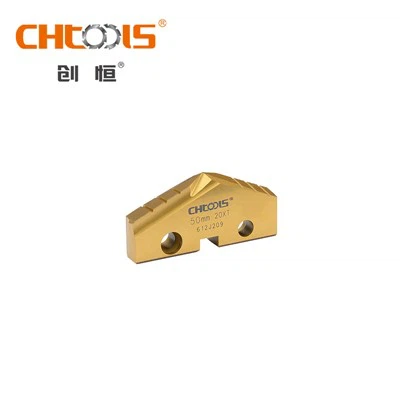
Hey there! As a supplier of Spade Drill Inserts, I often get asked about the spindle speed range for these nifty tools. So, I thought I'd write a blog post to shed some light on this topic.
First off, let's quickly understand what a Spade Drill Insert is. A Spade Drill Insert is a cutting tool used in machining operations, mainly for drilling holes in various materials. It's designed to be inserted into a Spade Drill Holder, which holds it securely in place during the drilling process.
The spindle speed range for a Spade Drill Insert is crucial because it affects the quality of the hole, the tool life, and the overall efficiency of the drilling operation. If you run the spindle too slow, the insert may not cut through the material effectively, leading to poor hole quality and increased wear on the insert. On the other hand, if you run the spindle too fast, you risk overheating the insert, which can cause it to break or wear out prematurely.
So, what factors determine the appropriate spindle speed range for a Spade Drill Insert? Well, there are several key considerations.
Material Being Drilled
The type of material you're drilling is one of the most important factors. Different materials have different hardness and machinability characteristics, which means they require different spindle speeds.
- Soft Materials (e.g., Aluminum, Brass): These materials are relatively easy to drill, so you can typically use higher spindle speeds. For aluminum, a good starting point for spindle speed might be around 1000 - 3000 RPM (Revolutions Per Minute). Brass is also quite soft, and you can use similar speeds, perhaps in the range of 800 - 2500 RPM.
- Medium-Hard Materials (e.g., Mild Steel): Mild steel is a bit more challenging to drill than soft materials. You'll need to reduce the spindle speed to ensure a clean cut and prevent excessive wear on the insert. A typical spindle speed range for mild steel would be around 300 - 800 RPM.
- Hard Materials (e.g., Stainless Steel, Titanium): These materials are very tough and require even lower spindle speeds. For stainless steel, you might start with a speed of around 100 - 300 RPM. Titanium is even more difficult to drill, and speeds in the range of 50 - 200 RPM are often recommended.
Drill Diameter
The diameter of the drill also plays a role in determining the spindle speed. Generally, larger diameter drills require lower spindle speeds. This is because the outer edge of a larger drill travels a greater distance in one revolution, so it experiences more force and generates more heat. For example, if you're using a small Spade Drill Insert with a diameter of 1/4 inch (6.35 mm), you might be able to use a relatively high spindle speed. But if you're using a larger insert with a diameter of 1 inch (25.4 mm), you'll need to reduce the speed to prevent damage.
Cutting Conditions
Other cutting conditions, such as the feed rate (the rate at which the drill advances into the material) and the type of coolant used, can also affect the optimal spindle speed. A higher feed rate generally requires a lower spindle speed, as the insert has to remove more material per revolution. Using a coolant can help dissipate heat and reduce friction, allowing you to use slightly higher spindle speeds.
Now that we've covered the factors that influence spindle speed, let's talk about how to calculate the appropriate range for your specific application. One common method is to use the following formula:
[ V = \frac{\pi \times D \times N}{12} ]
Where:
- ( V ) is the cutting speed in surface feet per minute (SFM)
- ( D ) is the drill diameter in inches
- ( N ) is the spindle speed in RPM
To use this formula, you first need to determine the recommended cutting speed for the material you're drilling. You can find this information in machining handbooks or by consulting with the insert manufacturer. Once you have the cutting speed, you can rearrange the formula to solve for the spindle speed:
[ N = \frac{12 \times V}{\pi \times D} ]
For example, let's say you're drilling mild steel with a Spade Drill Insert that has a diameter of 1/2 inch (12.7 mm), and the recommended cutting speed for mild steel is 100 SFM. Plugging these values into the formula, we get:
[ N = \frac{12 \times 100}{\pi \times 0.5} \approx 764 \text{ RPM} ]
Keep in mind that this is just a starting point, and you may need to adjust the speed based on your specific cutting conditions and the performance of the insert.
In addition to calculating the spindle speed, it's also important to monitor the drilling process and make adjustments as needed. Pay attention to the sound of the drill, the quality of the chips being produced, and the temperature of the insert. If the drill is making a loud screeching noise, the chips are too long and stringy, or the insert is getting too hot, it may be a sign that the spindle speed is too high or too low.
As a Spade Drill Insert supplier, I understand the importance of providing high-quality products and accurate information to our customers. We offer a wide range of Spade Drill Inserts, Spade Drill Holders, and Carbide Insert Drill Bits to meet the needs of different applications. Our experts are always available to help you select the right tools and determine the optimal cutting parameters for your specific job.
If you're in the market for Spade Drill Inserts or have any questions about spindle speed or other cutting parameters, don't hesitate to reach out. We're here to help you get the most out of your machining operations and achieve the best possible results.
So, whether you're a seasoned machinist or just starting out, understanding the spindle speed range for a Spade Drill Insert is essential for successful drilling. By taking into account the material being drilled, the drill diameter, and the cutting conditions, you can select the appropriate speed and ensure a high-quality finish, long tool life, and efficient production.


If you're interested in learning more or discussing your specific requirements, feel free to get in touch. Let's work together to find the perfect Spade Drill Insert solution for your needs!
References
- Machinery's Handbook: A comprehensive reference book for machining operations, which provides detailed information on cutting speeds, feeds, and other machining parameters.
- Insert Manufacturer's Technical Documentation: Most Spade Drill Insert manufacturers provide technical data sheets and guidelines that include recommended spindle speeds for different materials and drill diameters.