


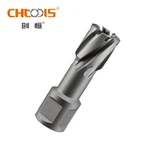
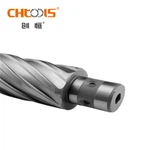
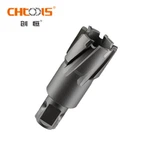
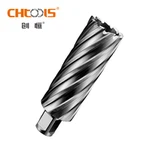


Carbide Countersink Drill Bit
Diameter:10.4-31mm
Hand angle: 90°
1. Carbide Countersink Bit with Fine grinding, stable performance;
2. Special groove, special for high hardness material work.
3. Applicable to processed materials HRC more than 30
4. Special cutting geometry for hard materials
|
Model |
C30-NQH |
|
Brand |
CHTOOLS |
|
Applicable material |
Various steel material, steel plate, stainless steel, aluminum, brass, cast iron, etc. |
|
L1 |
45-71mm |
the Advantages of Carbide Countersink Bit
Excellent material
Made of high-quality cemented carbide materials, featuring high hardness, wear resistance, and heat resistance. This ensures the service life of the cutter.
01
High machining accuracy
Formed by high-precision grinding, the cutting edge is sharp and precise, enabling accurate chamfering processing. It makes the workpiece surface smooth and flat.
02
Good cutting performance
The large core diameter design enhances the rigidity and anti-vibration performance of the cutter.
03
Wide applicability
With a rich variety and complete specifications, and the ability to be customized as needed, it can meet the diversified needs of different users.
04

Carbide Countersink Bit 's FAQ
Q: 1.Why do you countersink holes?
+
-
A: Countersinking is a great way to make the fasteners in your design flush with the parts they're connecting.
Q: 2. Do you need to countersink?
+
-
A: In general, you should use a countersink hole whenever the appearance, safety, or structural integrity of the project demands a flush screw or bolt head.
Q: 3.What is the meaning of countersinking?
+
-
A: Countersinking is a machining process used to create a conical hole at the top of a pre-drilled hole. This conical hole is designed to allow the head of a flat or countersunk screw to sit flush with or below the surface of the material.
Q: 4.Is a countersink a chamfer?
+
-
A: A countersink hole can be chamfered. However, in practicality, these two types of holes are distinguished from each other in function, thus resulting in two distinct gages needed for their measurement.
Q: 5.What is the difference between a bore and a countersink?
+
-
A: The difference between them is the angle at which the larger hole is drilled. A countersink's larger hole is tapered at an angle; whereas a counterbore is drilled straight into the material and leaves a flat bottom between the counterbore and the narrower inner shaft
Hot Tags: carbide countersink drill bit, China carbide countersink drill bit manufacturers, suppliers, factory, Carbide Countersink Bit For Metal, carbide countersink, 2 Inch Countersink Bit, Carbide Tipped Countersink Bit, Carbide Countersink Drill Bit, Carbide Countersink Bit
Previous
Carbide Countersink BitNext
No InformationYou Might Also Like


Send Inquiry