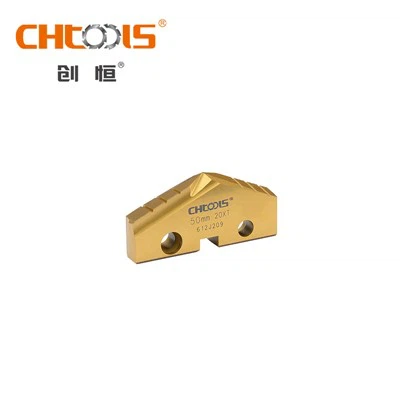
As a supplier of Indexable Drills, I'm often asked about the programming methods for using these tools in CNC machines. In this blog post, I'll share some in - depth knowledge about this topic, which will be useful for both novice and experienced machinists.
Understanding Indexable Drills
Indexable drills are a type of cutting tool used in machining operations. They consist of a drill body and replaceable cutting inserts. The advantage of indexable drills is that when the cutting edge of the insert wears out, you can simply index the insert to expose a new cutting edge or replace the insert entirely, instead of discarding the whole drill. This not only reduces tooling costs but also increases efficiency.
Pre - programming Considerations
Before starting the programming process, several factors need to be taken into account. First, you need to understand the material of the workpiece. Different materials, such as steel, aluminum, or titanium, have different cutting properties. For example, steel is generally harder than aluminum, so you'll need to adjust the cutting speed and feed rate accordingly.
Second, the diameter and depth of the hole to be drilled are crucial. Larger diameter holes may require more power and different feed and speed settings compared to smaller ones. Deeper holes also pose challenges, such as chip evacuation and tool deflection.
Basic Programming Steps for Indexable Drills in CNC Machines
Step 1: Tool Selection and Setup
The first step in programming is to select the appropriate indexable drill for the job. Consider the diameter of the hole, the material of the workpiece, and the required hole quality. Once you've selected the drill, you need to set it up in the CNC machine. This involves mounting the drill in the spindle and setting the tool length offset.
Step 2: Defining the Program Zero Point
The program zero point is the reference point from which all the coordinates in the CNC program are measured. It is usually set at a convenient location on the workpiece, such as a corner or the center of a circular feature.
Step 3: Setting Feed and Speed Rates
The feed rate is the speed at which the drill advances into the workpiece, and the cutting speed is the speed at which the cutting edge of the drill moves relative to the workpiece. These values depend on the material of the workpiece, the drill diameter, and the type of insert used. For example, when drilling aluminum, you can typically use a higher feed and speed rate compared to drilling steel.
The formula for calculating the cutting speed (V) is (V=\pi DN/1000), where D is the drill diameter in millimeters and N is the spindle speed in revolutions per minute (RPM). The feed rate (F) is usually given in millimeters per revolution (mm/rev).
Step 4: Writing the CNC Program
The CNC program for indexable drills typically consists of a series of commands that control the movement of the drill. Here is a simple example of a CNC program for drilling a single hole:


O1000 ; Program number
N10 G21 ; Set units to millimeters
N20 G90 ; Set absolute programming mode
N30 T01 M06 ; Select tool 01 (indexable drill) and change tool
N40 S1000 M03 ; Set spindle speed to 1000 RPM and start spindle clockwise
N50 G00 X50 Y50 ; Rapid move to the X and Y coordinates of the hole
N60 G01 Z - 20 F0.2 ; Feed the drill into the workpiece at a feed rate of 0.2 mm/rev to a depth of - 20 mm
N70 G00 Z5 ; Rapid retract the drill to a safe height
N80 M05 ; Stop the spindle
N90 M30 ; End the program
In this program, G21 sets the units to millimeters, G90 sets the absolute programming mode, T01 M06 selects the indexable drill, S1000 M03 starts the spindle at 1000 RPM, G00 is used for rapid movement, and G01 is used for linear interpolation (feeding the drill into the workpiece).
Advanced Programming Techniques
Peck Drilling
Peck drilling is a technique used for deep hole drilling. Instead of drilling the entire depth in one pass, the drill is retracted periodically to evacuate chips. This helps prevent chip clogging, which can lead to tool breakage and poor hole quality.
The following is an example of a peck - drilling program:
O2000 ; Program number
N10 G21 ; Set units to millimeters
N20 G90 ; Set absolute programming mode
N30 T01 M06 ; Select tool 01 (indexable drill) and change tool
N40 S1000 M03 ; Set spindle speed to 1000 RPM and start spindle clockwise
N50 G00 X50 Y50 ; Rapid move to the X and Y coordinates of the hole
N60 G83 Z - 50 R5 Q10 F0.2 ; Peck drill to a depth of - 50 mm, retract to a reference plane of 5 mm above the workpiece, peck depth of 10 mm, and feed rate of 0.2 mm/rev
N70 G00 Z5 ; Rapid retract the drill to a safe height
N80 M05 ; Stop the spindle
N90 M30 ; End the program
In this program, G83 is the peck - drilling cycle command.
Circular Drilling
Circular drilling is used when you need to drill a series of holes in a circular pattern. You can use the G02 or G03 commands for circular interpolation.
O3000 ; Program number
N10 G21 ; Set units to millimeters
N20 G90 ; Set absolute programming mode
N30 T01 M06 ; Select tool 01 (indexable drill) and change tool
N40 S1000 M03 ; Set spindle speed to 1000 RPM and start spindle clockwise
N50 G00 X0 Y0 ; Rapid move to the center of the circle
N60 G02 X20 Y0 I10 J0 ; Circular interpolation to drill a hole at a radius of 20 mm
N70 G00 Z5 ; Rapid retract the drill to a safe height
N80 M05 ; Stop the spindle
N90 M30 ; End the program
In this program, G02 is used for clockwise circular interpolation, and I and J are the offsets from the starting point to the center of the circle.
Importance of Tooling Accessories
When using indexable drills, tooling accessories play an important role. For example, Carbide Insert Drill Bit provides a sharp and durable cutting edge, which can improve the hole quality and extend the tool life. Carbide Insert Of Spade Drill is specifically designed for spade drills, and it can enhance the cutting performance. Spade Drill Holder ensures the proper mounting and stability of the drill, which is crucial for accurate machining.
Conclusion
Programming indexable drills in CNC machines requires a good understanding of the tool, the workpiece material, and the CNC programming language. By following the basic steps and using advanced techniques, you can achieve efficient and accurate hole - drilling operations.
If you're interested in purchasing high - quality indexable drills or have any questions about programming methods, please feel free to contact us for a detailed discussion and procurement negotiation. We are committed to providing you with the best products and technical support.
References
- "CNC Programming Handbook" by John A. Reha
- "Machining Fundamentals" by Robert L. Norton