The feed rate of an insert drill is a crucial parameter in the machining process, significantly influencing the efficiency, quality, and cost of production. As a supplier of insert drills, understanding and communicating the concept of feed rate is essential for providing our customers with the best possible solutions for their machining needs.
Understanding Feed Rate
Feed rate, in the context of an insert drill, refers to the distance the drill advances into the workpiece per revolution. It is typically measured in millimeters per revolution (mm/rev) or inches per revolution (ipr). This parameter, along with cutting speed (the speed at which the cutting edge of the drill moves relative to the workpiece), determines the material removal rate (MRR) and the quality of the machined surface.
A higher feed rate generally leads to a greater MRR, which means more material can be removed in a shorter time, increasing productivity. However, if the feed rate is too high, it can cause excessive wear on the drill inserts, poor surface finish, and even breakage of the drill. On the other hand, a very low feed rate may result in inefficient machining, longer cycle times, and increased production costs.
Factors Affecting Feed Rate
Several factors need to be considered when determining the appropriate feed rate for an insert drill:
Workpiece Material
Different materials have different mechanical properties, such as hardness, toughness, and thermal conductivity. Harder materials, like stainless steel or titanium, require lower feed rates to avoid excessive tool wear and breakage. Softer materials, such as aluminum or brass, can generally tolerate higher feed rates. For example, when drilling aluminum, a feed rate of 0.2 - 0.5 mm/rev might be suitable, while for stainless steel, a feed rate of 0.05 - 0.2 mm/rev could be more appropriate.
Drill Geometry
The design of the insert drill, including the number of cutting edges, the shape of the inserts, and the flute geometry, affects the feed rate. Drills with more cutting edges can typically handle higher feed rates because the load is distributed over a larger area. Additionally, inserts with a positive rake angle can reduce cutting forces, allowing for higher feed rates.


Machine Tool Capability
The power, torque, and rigidity of the machine tool play a significant role in determining the maximum feed rate. A machine with high power and torque can handle higher feed rates without stalling or vibrating excessively. The rigidity of the machine also affects the stability of the drilling process, which is crucial for achieving accurate results and preventing tool breakage.
Coolant and Lubrication
Proper coolant and lubrication can improve the cutting conditions by reducing friction, dissipating heat, and flushing away chips. Using a coolant can allow for higher feed rates because it helps to maintain the sharpness of the drill inserts and prevents built - up edge formation. Different types of coolants, such as water - based emulsions or synthetic coolants, have different effects on the feed rate and should be selected based on the workpiece material and the machining requirements.
Calculating Feed Rate
There are several methods for calculating the appropriate feed rate for an insert drill. One common approach is to refer to the manufacturer's recommendations. Drill manufacturers usually provide feed rate charts based on the type of drill, workpiece material, and other relevant factors. These charts are a good starting point for determining the feed rate, but they may need to be adjusted based on the specific conditions of the machining operation.
Another method is to use empirical formulas. One such formula for calculating the feed rate (f) is:
[f=\frac{MRR}{v\times d}]
where MRR is the material removal rate, v is the cutting speed, and d is the diameter of the drill. However, this formula requires accurate knowledge of the MRR, which can be difficult to determine precisely in practice.
In addition, modern machining centers often have built - in software that can calculate the feed rate based on the input parameters, such as workpiece material, drill diameter, and cutting speed. These software programs use advanced algorithms and databases to provide optimized feed rate values for different machining operations.
Importance of Feed Rate in Machining
Productivity
As mentioned earlier, the feed rate directly affects the material removal rate. By optimizing the feed rate, manufacturers can increase the productivity of their machining operations. For example, in a mass - production environment, even a small increase in the feed rate can result in significant time savings over the course of thousands of parts.
Surface Finish
The feed rate also has a significant impact on the surface finish of the machined hole. A too - high feed rate can cause rough surfaces, chatter marks, and burrs, while a too - low feed rate may lead to a smooth but inefficiently machined surface. Finding the right balance is crucial for achieving the desired surface quality.
Tool Life
Proper selection of the feed rate can extend the tool life of the insert drill. When the feed rate is too high, the cutting edges of the inserts are subjected to excessive forces and wear, leading to premature tool failure. By using an appropriate feed rate, the inserts can maintain their sharpness for a longer time, reducing the frequency of tool changes and the overall cost of production.
Our Insert Drill Offerings
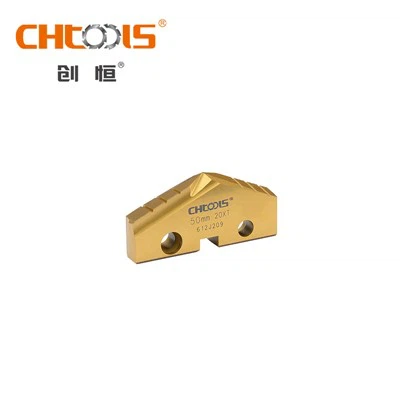
As a leading supplier of insert drills, we offer a wide range of Indexable Drill Bit and Indexable Drill products designed to meet the diverse needs of our customers. Our drills are equipped with high - quality Spade Drill Insert that are made from advanced materials, such as carbide or ceramic, to ensure excellent wear resistance and cutting performance.
We understand that every machining application is unique, and we work closely with our customers to provide customized solutions. Our technical support team can assist in selecting the right drill and determining the optimal feed rate based on the specific requirements of the machining operation. Whether you are drilling small - diameter holes in a precision component or large - diameter holes in a heavy - duty workpiece, we have the expertise and the products to meet your needs.
Conclusion
The feed rate of an insert drill is a complex but essential parameter in the machining process. It is influenced by multiple factors, including workpiece material, drill geometry, machine tool capability, and coolant usage. By understanding these factors and using appropriate calculation methods, manufacturers can optimize the feed rate to improve productivity, surface finish, and tool life.
As a supplier of insert drills, we are committed to providing our customers with the highest quality products and the best technical support. If you are looking for reliable insert drills and need assistance in determining the appropriate feed rate for your machining operations, we encourage you to [contact us for a purchase negotiation](contact link placeholder). Our team of experts is ready to work with you to find the most suitable solutions for your needs.
References
- "Machining Handbook", Various Editions, Industrial Press Inc.
- "Cutting Tool Engineering", Monthly Magazine, Society of Manufacturing Engineers
- Technical Documentation from Insert Drill Manufacturers