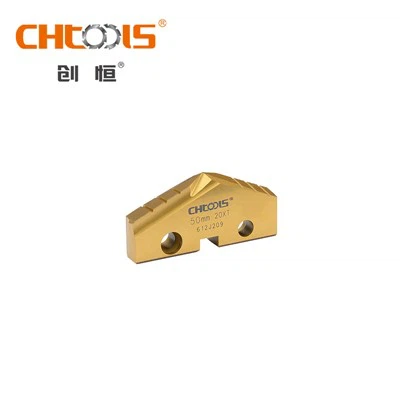
Hey there! As a supplier of Spade Drill Inserts, I often get asked whether these inserts can be used for hard materials. It's a great question, and today, I'm gonna break it down for you.
First off, let's talk a bit about what Spade Drill Inserts are. They're a key part of a Spade Drill Holder, which is a tool used in machining operations. These inserts are designed to cut through various materials, making them super versatile in the manufacturing world. You can find them in Indexable Drill setups, where they can be easily replaced when worn out, saving both time and money.
Now, when it comes to hard materials, things get a bit more complicated. Hard materials, like hardened steel, titanium, and some types of ceramics, have unique properties that make them tough to cut. They have high strength, which means they can resist deformation under pressure. And they often have a high hardness value, measured on the Rockwell or Brinell scale.
So, can a Spade Drill Insert handle these hard materials? The short answer is, it depends. There are different types of Spade Drill Inserts, and not all of them are created equal. Some are made from high - speed steel (HSS), which is a common and relatively inexpensive material for cutting tools. HSS inserts are great for softer materials like aluminum and mild steel. They can cut these materials efficiently and with a good surface finish. But when it comes to hard materials, HSS inserts tend to wear out quickly. The high heat generated during the cutting process can cause the HSS to lose its hardness, leading to dulling and a decrease in cutting performance.
On the other hand, Carbide Insert Of Spade Drill are a different story. Carbide is a much harder and more heat - resistant material compared to HSS. It's made up of tungsten carbide particles held together by a metallic binder, usually cobalt. Carbide inserts can withstand the high temperatures and pressures generated when cutting hard materials. They have a longer tool life, which means you don't have to replace them as often. This can lead to significant cost savings in the long run, especially in high - volume production environments.
However, using carbide Spade Drill Inserts for hard materials isn't without its challenges. One of the main issues is the brittleness of carbide. If the cutting conditions aren't right, the insert can chip or break. For example, if the feed rate is too high or the cutting speed is too low, it can put excessive stress on the insert, causing it to fail. So, it's crucial to optimize the cutting parameters when using carbide inserts on hard materials.
Let's talk about the cutting parameters in more detail. When drilling hard materials with a Spade Drill Insert, you need to consider the cutting speed, feed rate, and depth of cut. The cutting speed is the speed at which the insert moves relative to the workpiece. For hard materials, a lower cutting speed is usually recommended to reduce the heat generated during cutting. This helps to prevent the insert from overheating and losing its hardness.
The feed rate is the distance the insert advances into the workpiece per revolution. A lower feed rate is also advisable when cutting hard materials. This reduces the force on the insert and helps to prevent chipping. However, if the feed rate is too low, it can lead to a poor surface finish and longer machining times.
The depth of cut is the thickness of the material removed in each pass. For hard materials, a smaller depth of cut is often better. This reduces the load on the insert and makes it easier to control the cutting process.
Another factor to consider is the geometry of the Spade Drill Insert. Different geometries are designed for different applications. For hard materials, inserts with a sharp cutting edge and a positive rake angle can be beneficial. A sharp cutting edge reduces the cutting force, while a positive rake angle helps to chip evacuation. However, a positive rake angle can also make the insert more prone to chipping, so it needs to be balanced with the strength requirements of the cutting operation.

In addition to the insert itself, the quality of the Spade Drill Holder is also important. A good holder provides a stable platform for the insert, ensuring accurate and consistent cutting. It should have a high clamping force to prevent the insert from moving during the cutting process. Any movement can lead to poor cutting performance and premature insert wear.
So, to sum it up, a Spade Drill Insert can be used for hard materials, but you need to choose the right type of insert and optimize the cutting parameters. Carbide inserts are generally a better choice for hard materials due to their high hardness and heat resistance. However, you need to be careful with their brittleness and make sure the cutting conditions are right.
If you're in the market for Spade Drill Inserts for hard materials, I'd love to help. We have a wide range of high - quality inserts, including carbide ones, that are designed to handle the toughest cutting jobs. Whether you're a small - scale workshop or a large manufacturing plant, we can provide you with the right solution for your needs. Just reach out, and we can start a conversation about your specific requirements.
References
- "Machining Handbook" by Industrial Press Inc.
- "Cutting Tool Engineering" magazine articles on drill inserts and hard materials machining.